250 Years from Mr. freedman
JULY 4 - AUGUST 1, 2026
LOCATION
Navy Yard Charleston (Storehouse 8)
2154 Noisette Blvd , N. Chas, S.C. 29405
GALLERY HOURS
Thurs - Sat 12p - 5p
GALLERY
Suite 207 • 2nd Floor via Stairs or Elevator
About the Work
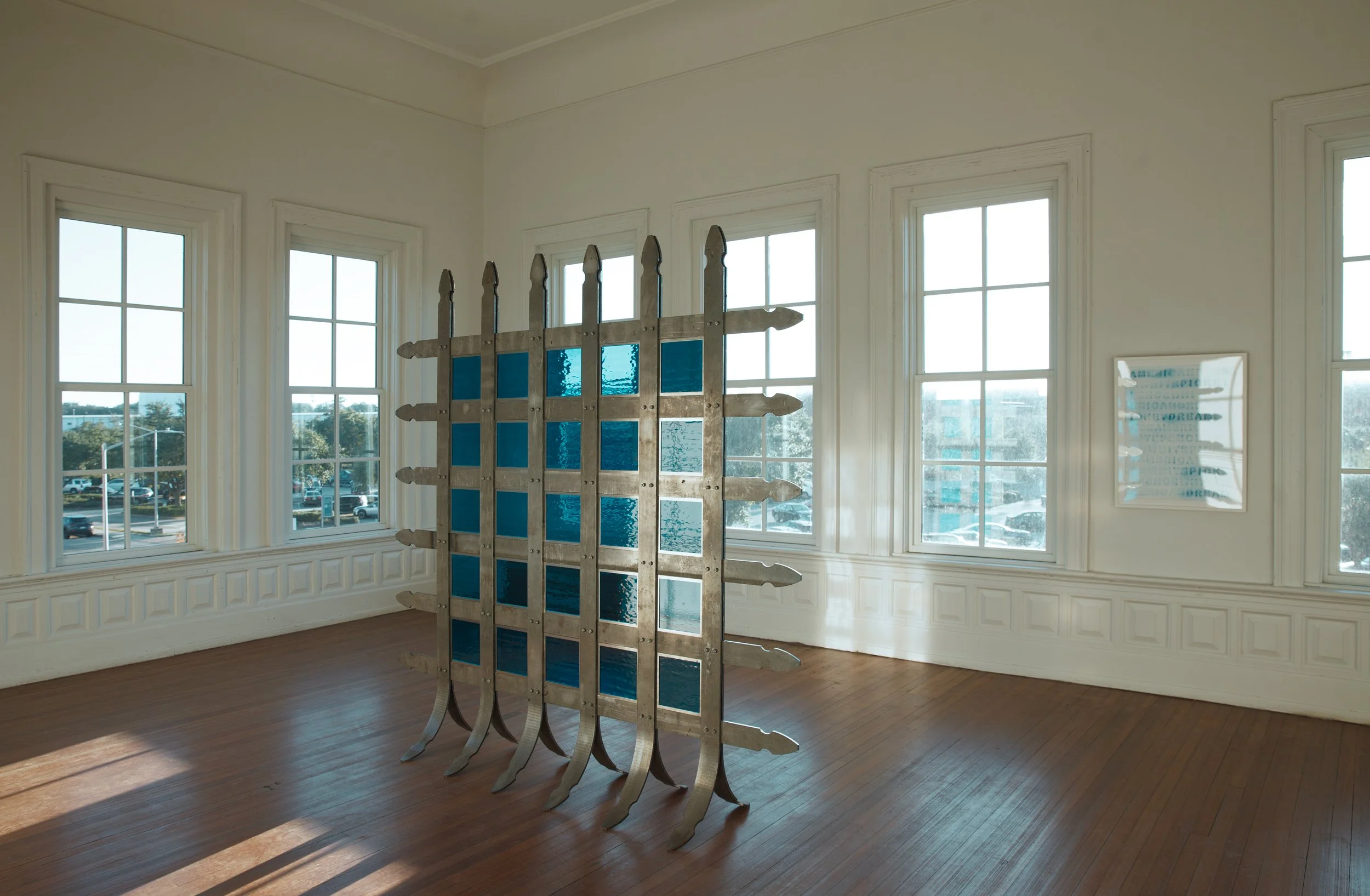
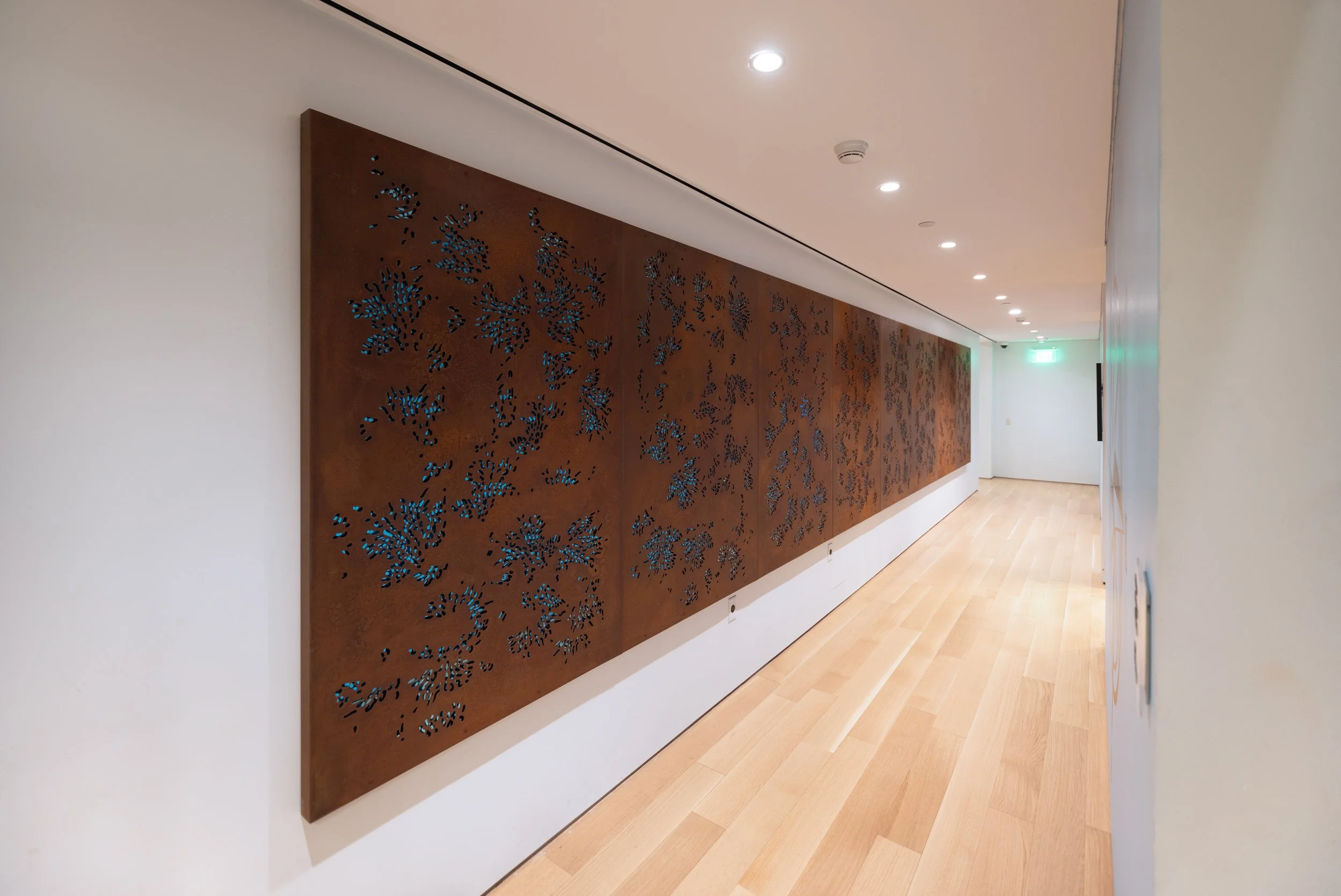
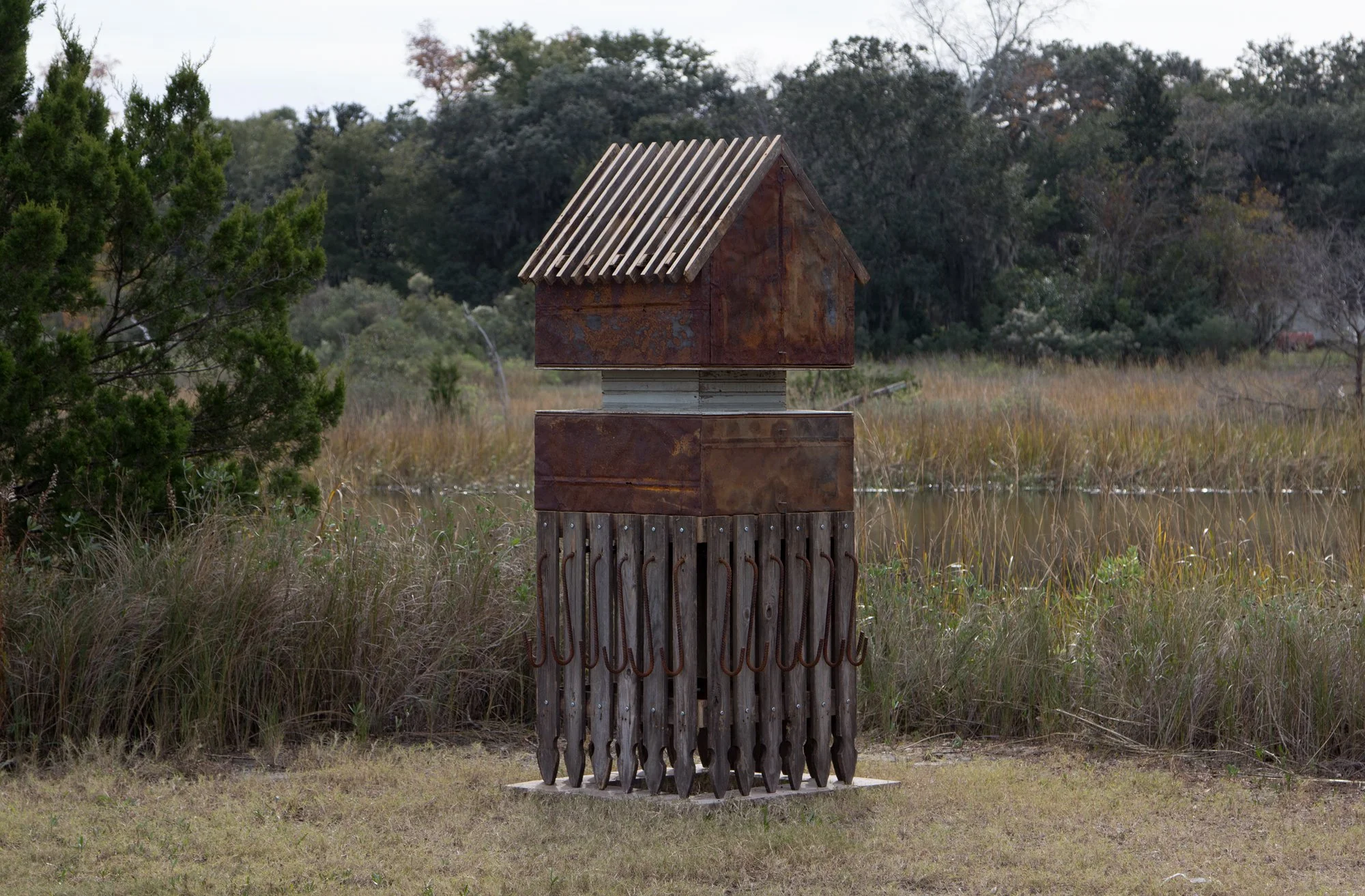
250 Years from Mr. Freedman is a solo exhibition by Fletcher Williams III presented in conjunction with the 250th anniversary of the United States. Bringing together a series of wall reliefs created from the tin roof of a burned Freedom Cottage in Charleston, South Carolina, the exhibition draws from Revolutionary-era history, personal memory regional mythology, and national symbolism. Williams approaches the world of Mr. Freedman not as a fixed history to be reconstructed or authoritatively told, but as an imaginative world to be entered and experienced.
The sculptures develop through association, as historical fragments, remembered places, and lived encounters move through Williams’s imagination and into sculptural form. A sheet of salvaged tin may become a rose window informed by his experience of the Aiken-Rhett House; within it, a rose silhouette and a band of red, white, and blue stars bring architecture, memory, nature, and national imagery into conversation. In another work, a grasshopper carries a more intimate memory. It recalls Robert Smalls, a Charleston palm gatherer and maker whom Williams knew. Smalls traveled by bicycle collecting palm fronds to sell to local makers, including Williams. During their final meeting, he showed Williams a grasshopper he had folded from palm leaves—a small but profound moment in which the two recognized one another through artists. Smalls died only weeks later. Reimagined within Mr. Freedman’s world, the grasshopper brings personal memory into conversation with craft and folklore.
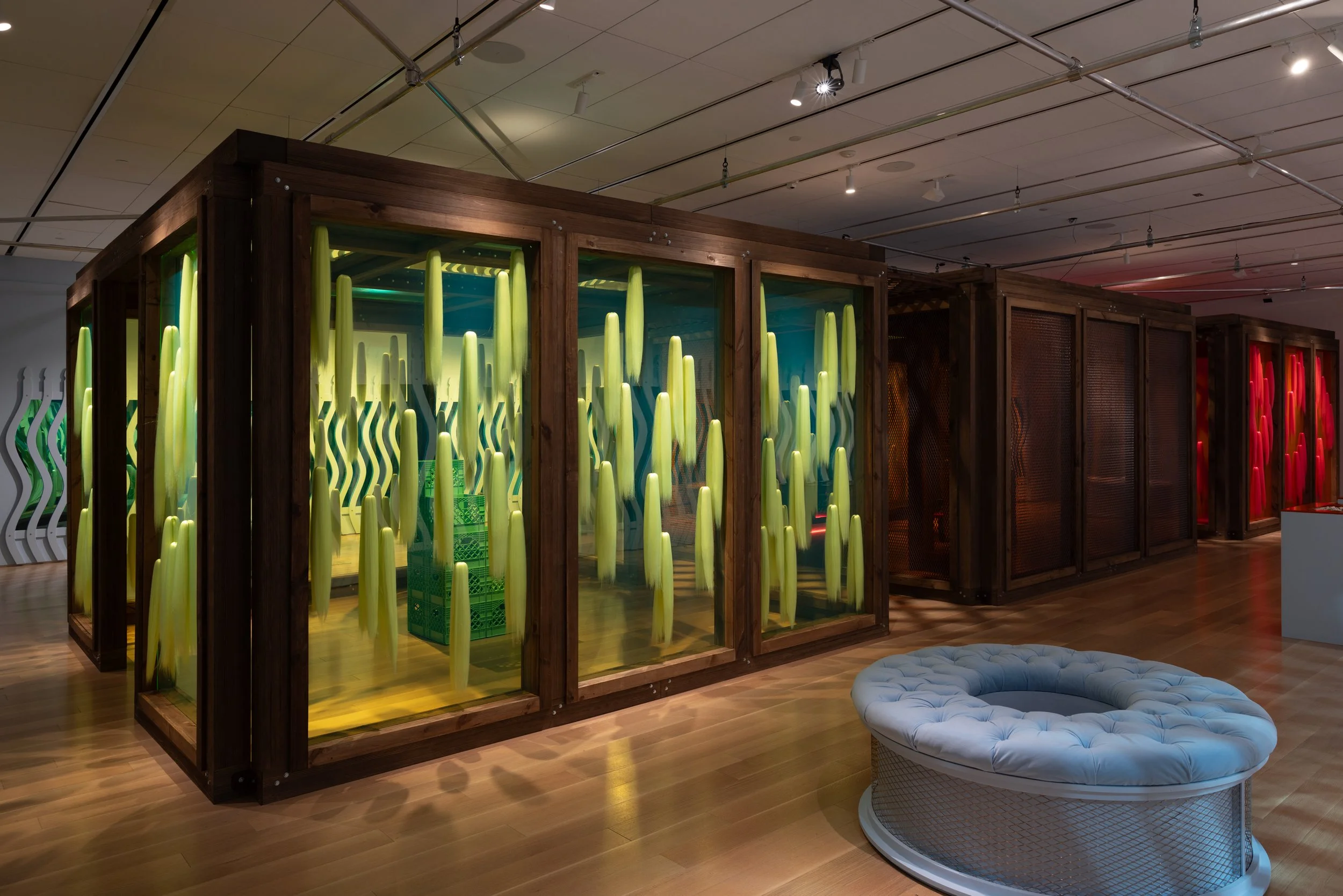
Mr. Freedman’s story functions as a medium through which Williams explores material, form, memory, place, and invention. Across the exhibition, birds, crosses, stars, bunting, fences, and other familiar forms do not carry single, stable meanings. They gather associations around faith and politics, death and hope, labor and ownership, celebration and dissent, personal memory and folklore. Mirror is also central to the work, used both as ornament and as a functioning reflective surface. It reflects the viewer, the surrounding room, and nearby sculptures. As viewers move through the exhibition, these reflections shift and become part of what they see in the work. The resulting sculptures move between historical reference and freely formed association, encouraging viewers to encounter them not simply as representations of history, but as artworks whose meanings remain open to interpretation. History provides the conditions from which these works emerge, but it does not determine their meaning.
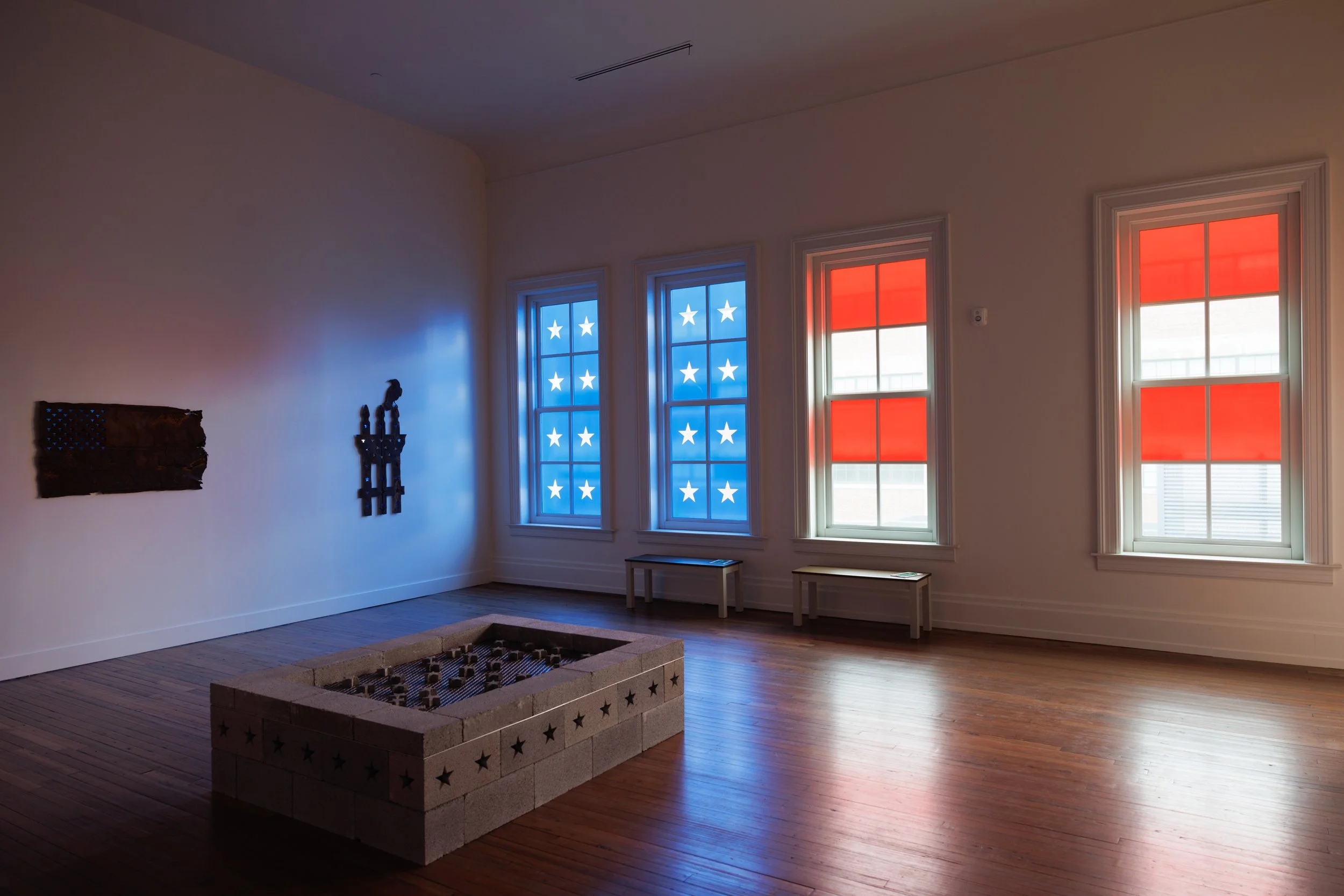
Presented during the United States semiquincentennial, 250 Years from Mr. Freedman places Mr. Freedman’s annual Fourth of July celebration in conversation with the symbols, rituals, and personal meanings that continue to shape American life. Flags and bunting occur in the exhibition as expressions of celebration and tradition, while also retaining space for contradiction and critique. This tension becomes most immersive in American Flag, a large-scale work whose proportions, luminosity, and commanding presence evoke a chapel window. Red and blue light tints the floor, walls, and surrounding sculptures. Here, the flag is not simply represented as an image; it becomes an atmosphere—grand, consuming, and difficult to stand apart from.
The exhibition does not ask viewers to approach the work through reverence alone. Instead, it invites them to experience the sculptures aesthetically—to enjoy them, question them, critique them, and form associations of their own.
The exhibition is accompanied by Eve of July 4th, a supporting narrative written by Fletcher Williams III. Rather than serving as a definitive explanation of the sculptures, the text offers one point of entry into Mr. Freedman’s world. It exists alongside the exhibition as another form through which history, fiction, memory, and artistic invention interact.
PRODUCTION AND CURATION
250 Years From Mr. Freedman was independently curated, produced, documented, and cataloged by Fletcher Williams III, who also designed the exhibition identity, logo, way-finding, signage, lighting, and site-specific vinyl window installation, American Flag.
Special thanks to Navy Yard Charleston for providing the exhibition space at Storehouse 8 in the Charleston Design District and for supporting the exhibition opening reception.
Collector Viewing Room
Sculptures and works on paper from 250 Years from Mr. Freedman remain available for acquisition. Access to the Collector Viewing Room is available upon request.
Already have a password? Enter Viewing Room
INTERVIEW AND PRESS
My Modern Met - Interview
Artist Transforms Rusted Tin Roof Salvaged From Charleston Fire Into American Iconography By Sage Helene - July 7, 2026
Post & Courier
North Charleston artist salvages tin from burnt Freedman’s cottage for 250th exhibit. By Wyatt Barczak - July 2, 2026
PLAYLIST
Listen to Mr. Freedman’s July 4th Spotify playlist
Acknowledgements
Fabrication Partners:
TTS Studios
Steve Aycock Designs
EVE OF JULY 4TH
If I hadn’t caught a patch of shade, I’d have missed them. Those stone windows, tucked behind a row of palms. It wasn’t that long ago that word of a Northern promise whistled through Charleston.
Some stayed. Some left a rose.
I wasn’t too far from Mr. Freedman’s home. I always knew I was getting close to his home when I’d see the eagles circling above. They followed the smoke. Just as I did.
After a few turns and some cobblestones later, I stepped into Mr. Freedman’s yard. And there it was, in the center of the yard. Splayed. Branded with a star. Smoking for hours. His prized hog.
I always missed the pit master. His work was quick. Precise. In and out. On to the next town. The coals burned bright and hot, tended to by a few of his nephews, while his sisters tidied the flags and shifted the stars into place, careful not to burn their fingers.
The yard was busy. Hog. Coals. Smoke.
Flags. Laughter. Kids chasing.
I got straight to work. I walked over to the porch to grab a few more stars. And there he was, twisting a palmetto frond. Someone hollered my name from the yard. “Three more over here.” When I turned back, he was gone. Hopped away.
The yard was nearly ready. Ready for another Fourth.
Another year. The sun was beginning to set.
From the porch I watched Mr. Freedman, counting his stars. Pointing and counting. Before he could finish, his crow glided in from the trees with the last fallen star. It burned bright. Mr. Freedman took it carefully and set it in place.
The yard sparkled. I left Mr. Freedman to it. I’d see him tomorrow.
by Fletcher Williams III
July 3, 2026
Accompanying Rust Paintings on Paper
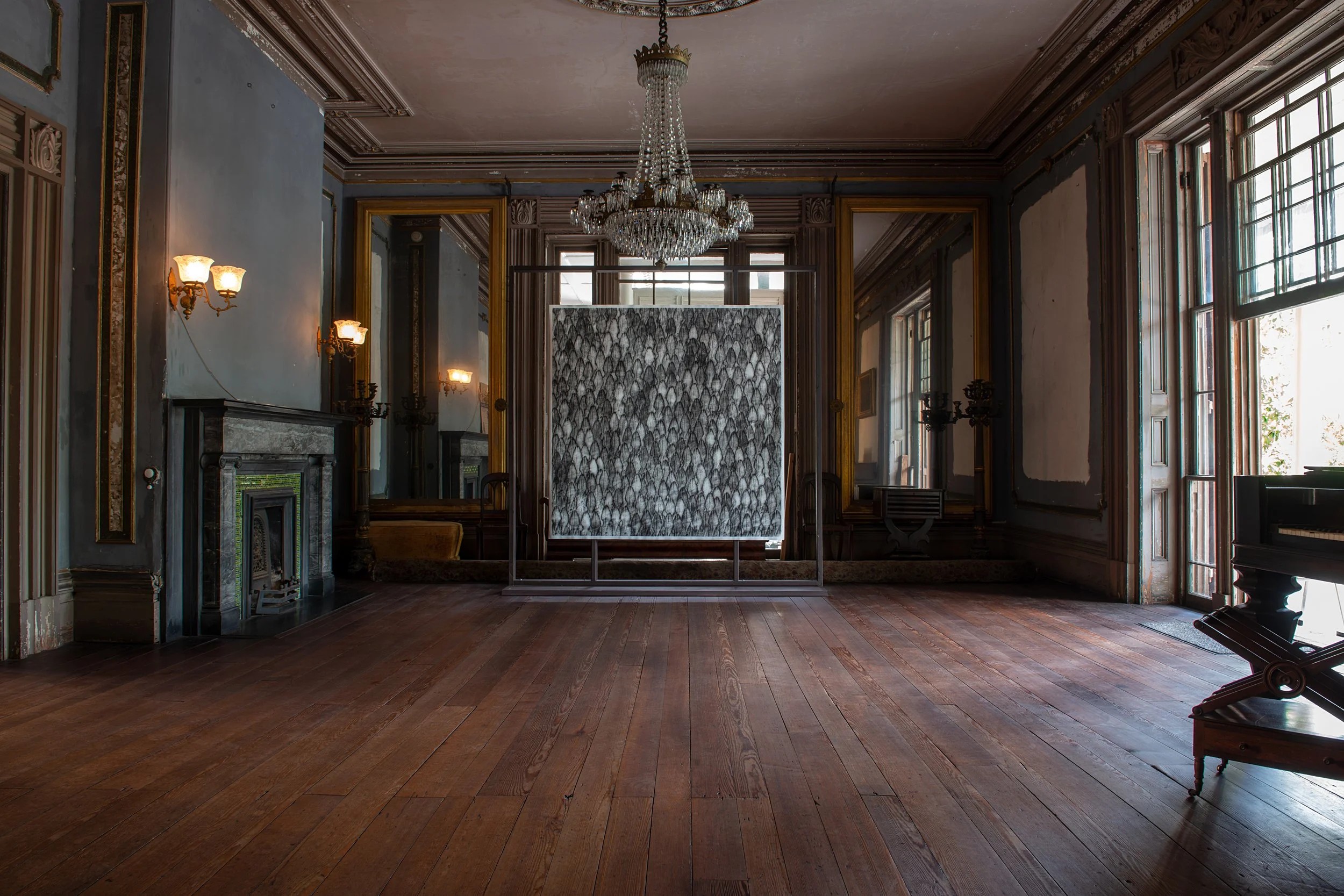
The sculptures are accompanied by a series of works on paper made by painting a rust solution directly onto the surface and allowing it to oxidize over several days. Because the rust develops differently in each work, the process produces tonal shifts, markings, and surface variations that cannot be repeated.
Reading List
Southern History, Public Art, and BBQ
Black Folk Tales and Chronicles of South Carolina
by Damon L Fordham
Denmark Vesey’s Garden
Slavery and Memory in the Cradle of the Confederacy
by Ethan J Kytle and Blain Roberts
Art and Landscape in Charleston and the Low Country
by John Beardsley
Places with a Past: New Site-specific Art at Charleston's Spoleto Festival
by Jacob, Mary Jane; Rosengarten, Theodore; Boltanski, Christian
The Cooking Gene: A Journey Through African American Culinary History in the Old South―A James Beard Award Winner
by Michael W. Twitty
High on the Hog: A Culinary Journey from Africa to America
by Jessica B. Harris
Rodney Scott's World of BBQ: Every Day Is a Good Day: A Cookbook
by Rodney Scott
Black Smoke: African Americans and the United States of Barbecue
by Adrian Miller
Black Smoke: African Americans and the United States of Barbecue
Adrian Miller in conversation with Justin Phillips
Episode 25: The Rise of the Urban Vultures - Charleston Time Machine
by Dr. Nic Butler
Windham Life and Times: Black History In New England
Windham NH History
july 4th Opening Reception | Photography by Jovon Roberts
RELATED WORKS
Homestead, 2018
View Project
Resting Place, 2020
Exhibition - Promiseland, 2020
Revising Divisive Language, 2018
View Project
Heirs To Master Builders, 2019
View Series